
Introduction
Many people hear about inequality in news, social discussions, or economic reports but don’t understand what it really means. Terms like Gini coefficient, Gini index, and income inequality measurement often seem complex and confusing. The problem is, without understanding these concepts, it’s hard to interpret data on wealth or income distribution.
The solution is simple: learning what is gini helps you understand how resources are shared in society. This guide explains the Gini coefficient in easy language, showing how it’s calculated, what it measures, and why it’s a valuable tool for policymakers, economists, and everyday citizens.
1. What Is Gini?
The term what is gini refers to the statistical measure called the Gini coefficient or Gini index. It was developed by the Italian statistician Corrado Gini in 1912.
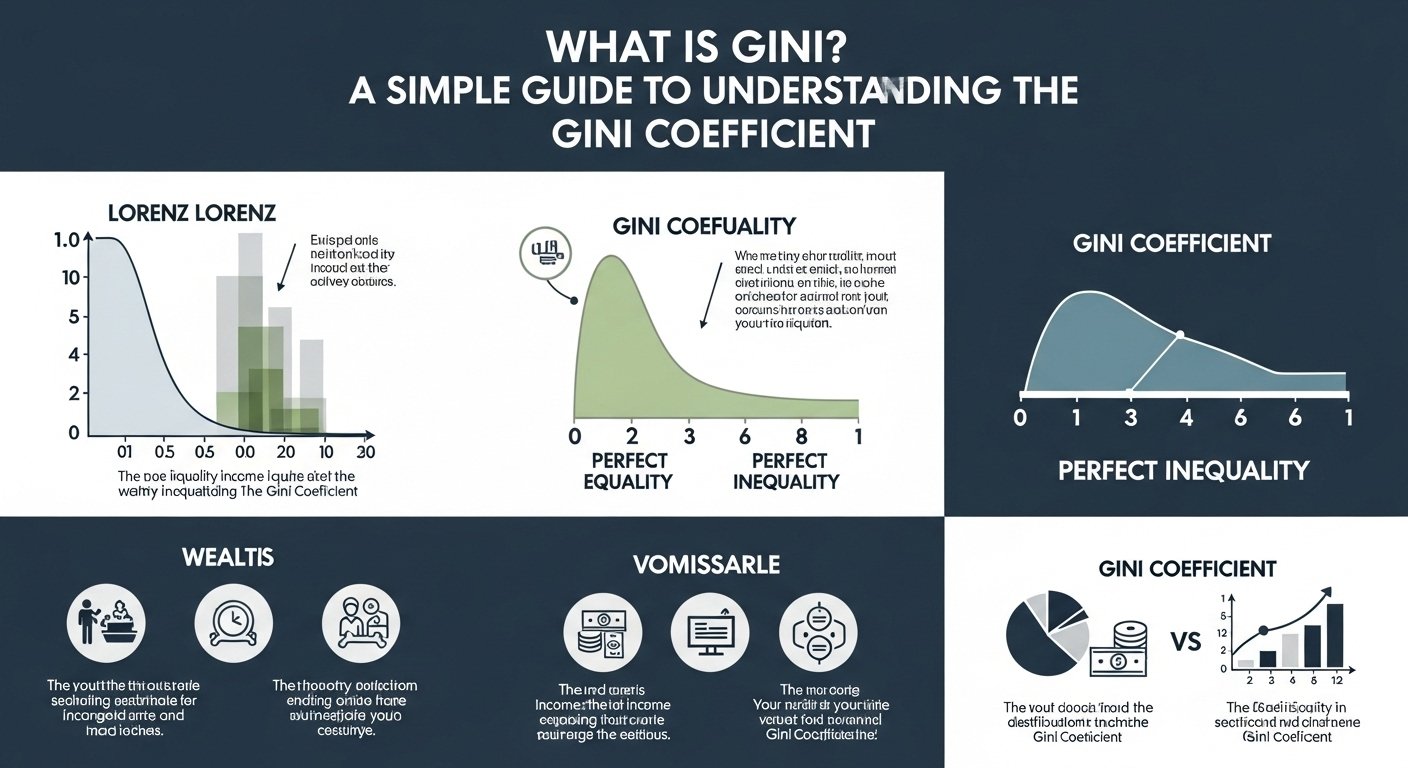
- A Gini coefficient of 0 indicates perfect equality, meaning everyone earns the same.
- A Gini coefficient of 1 (or 100 on the Gini index scale) indicates perfect inequality, meaning one person has all the income.
Because of its ability to summarize inequality with a single number, it is a widely used economic inequality indicator and key method for income inequality measurement worldwide.
2. Gini Coefficient vs Gini Index
You might see Gini coefficient and Gini index used interchangeably, but here’s the difference:
- Gini coefficient: Expressed as a number between 0 and 1.
- Gini index: The same value expressed as a percentage (0–100%).
Both measure the same concept: how evenly income or wealth is distributed. Knowing this distinction is useful when comparing reports from different countries.
3. Why Gini Matters
The Gini coefficient is important because it provides a simple measure of economic inequality. It helps answer questions like:
- How fairly is income shared in a society?
- Are policies helping reduce inequality?
- How does one country compare with another in terms of wealth distribution?
High inequality, indicated by a high Gini value, can signal social challenges like poverty, low social mobility, and economic instability. Understanding what is gini helps policymakers and researchers make informed decisions to improve fairness in society.
4. How Is the Gini Calculated (The Gini Formula)
The Gini formula uses a graphical approach called the Lorenz curve. The curve plots cumulative population on the x-axis and cumulative income on the y-axis.
Steps to calculate:
- Draw the Lorenz curve showing income distribution.
- Measure the area between the line of perfect equality and the Lorenz curve.
- Divide this area by the total area under the line of equality.
This produces the Gini coefficient, which can also be converted to the Gini index percentage.
Key point: The formula is simple in concept but gives powerful insight into inequality.
5. Interpreting Gini Values
Understanding the Gini value helps evaluate economic conditions:
- 0–0.3: Low inequality (fairly equal income distribution).
- 0.3–0.5: Moderate inequality (common in many developed countries).
- 0.5+: High inequality (common in some developing countries).
For instance, a country with a Gini coefficient of 0.25 has a relatively equal income distribution, whereas a coefficient of 0.55 indicates significant inequality.
6. Applications of the Gini Index
The Gini index is widely used across governments, research, and international organizations:
- To compare inequality between countries.
- To monitor inequality trends over time.
- To evaluate the effects of tax policies, social welfare programs, or reforms.
- Sometimes extended to wealth, land distribution, or other resources.
Using what is gini in practical ways helps make informed decisions in economics, social planning, and policy-making.
7. Strengths and Limitations
Strengths:
- Provides a single, clear measure of inequality.
- Useful for comparisons across populations and countries.
- Helps track changes over time.
Limitations:
- Doesn’t measure absolute poverty.
- Can hide inequalities at the very top or bottom of the income spectrum.
- Different distributions can have the same Gini coefficient.
Even with these limitations, the Gini coefficient remains a trusted economic inequality indicator.
8. Global Trends and Data
Data shows that Gini values differ significantly around the world:
- Countries like Sweden or Denmark have low Gini values (~0.25), showing low inequality.
- Countries like South Africa or Brazil have high Gini values (>0.50), showing significant inequality.
These trends are essential for governments and organizations to monitor social and economic health. By tracking the Gini, policymakers can target policies where inequality is high.
9. Policy Implications
Understanding what is gini can guide economic policy:
- Tax policy: Progressive taxes can reduce inequality.
- Social programs: Targeted welfare helps lower-income groups.
- Education and healthcare: Equal access reduces long-term disparities.
Businesses and investors may also consider Gini data when assessing economic stability and market potential in different countries.
10. Comparing Gini With Other Measures
While the Gini coefficient is the most popular measure of inequality, there are others, such as the Palma ratio or Theil index. These can provide additional insights, especially about extremes of wealth.
However, because of its simplicity and availability, the Gini remains the most widely cited and understood metric. It is an essential tool in understanding income inequality measurement.
Conclusion
The question what is gini is simple but powerful. The Gini coefficient or Gini index shows how income or wealth is distributed in a society. It is a key economic inequality indicator and widely used for income inequality measurement.
While it has limitations, the Gini coefficient provides a clear snapshot of inequality, helping policymakers, researchers, and citizens understand fairness in society. By using this measure along with other data, we can work toward better-informed decisions and more equitable outcomes.