
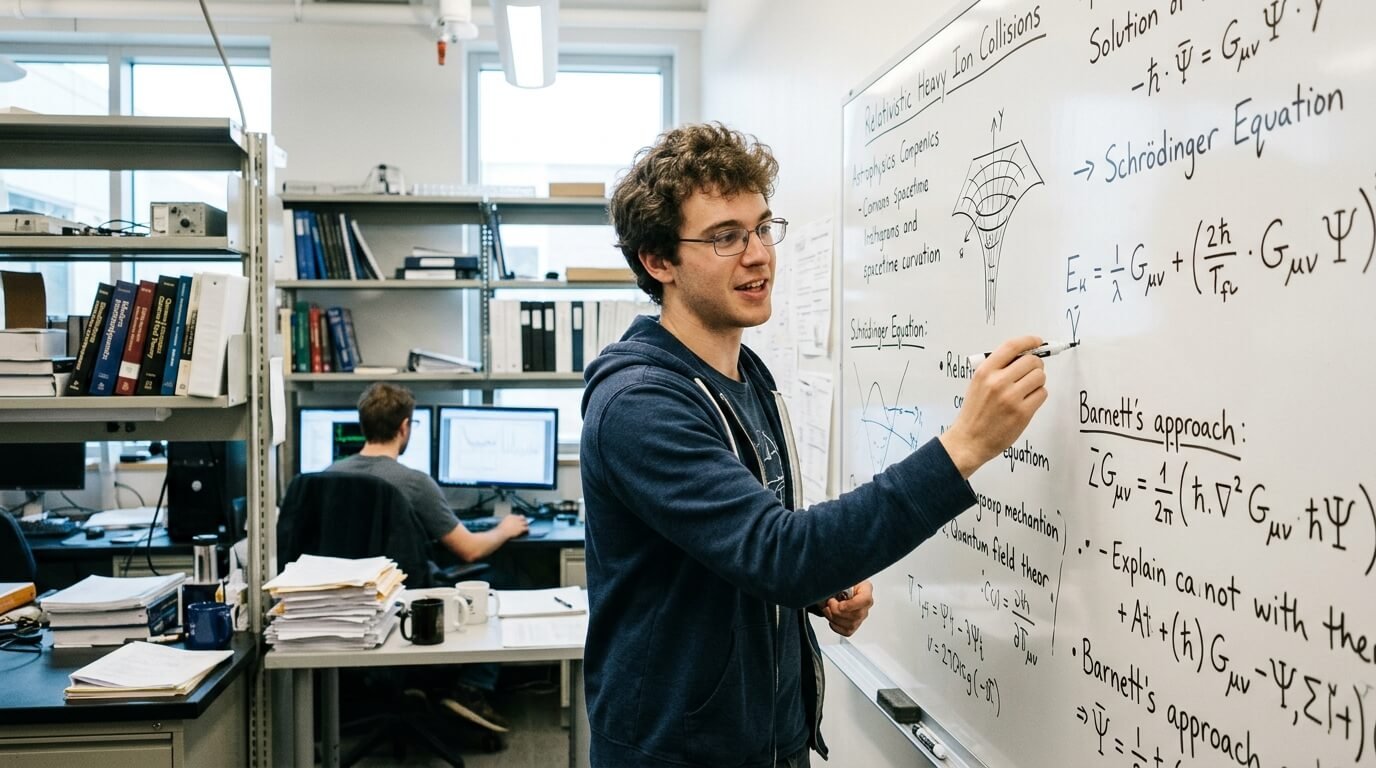
When people search for jacob barnett physics, they often find sensational stories about a child genius who supposedly challenged Einstein and possessed an extraordinary IQ. The real story is more interesting: Jacob Barnett developed an unusually early interest in advanced mathematics and physics, moved rapidly through university-level study, and eventually pursued research in quantum and non-Hermitian physics. The best way to understand his contribution is to separate verified academic work from media mythology. From his early university studies to research on loop quantum gravity, quasi-Hermitian quantum theory, and non-Hermitian systems, Barnett’s journey demonstrates how curiosity, independent thinking, and rigorous mathematical training can develop into serious scientific research.
Who Is Jacob Barnett?
Jacob Barnett is an American mathematician and physicist who became internationally known as a child prodigy. His early academic journey attracted attention because he began attending university-level physics lectures while still very young. TEDxTeen describes Barnett as a child prodigy who began attending college lectures at IUPUI at age eight and later became a full-time university student.
His story became particularly notable because his interests were not limited to elementary mathematics. He was drawn toward subjects such as calculus, quantum mechanics, condensed matter physics, relativity, and theoretical physics.
However, it is important to distinguish between Barnett’s verified academic record and some of the exaggerated claims that have circulated online. Headlines have sometimes described him as someone who “proved Einstein wrong,” but his documented research record is much more nuanced. His academic work has focused on difficult problems in mathematical and theoretical physics rather than simply overturning established theories.
That distinction is essential when discussing jacob barnett physics from an E-E-A-T perspective. Scientific achievement should be evaluated through published research, academic institutions, theses, and peer-reviewed or scholarly sources rather than viral headlines.
Jacob Barnett’s Early Interest in Physics
Barnett’s fascination with mathematics and physical patterns appeared remarkably early. His interest eventually led him toward university physics courses, where he studied material far beyond the typical curriculum for his age.
A TEDxTeen profile states that Barnett began attending college lectures at eight and later entered university formally. It also describes his early work in condensed matter physics and his publication in Physical Review A.
His early development illustrates an important point about advanced learning: exceptional students do not always progress through subjects at the same pace as their classmates. Barnett’s education became increasingly individualized because traditional grade-level material did not match his interests or abilities.
Instead of treating physics as a collection of formulas to memorize, he approached it as a system of relationships that could be explored mathematically.
From Child Prodigy to University Physics Student
Barnett’s transition from unusual childhood talent to formal scientific study is one of the most important parts of his story.
Perimeter Institute reports that he began auditing university physics courses at eight and later became a full-time university student. By age 15, he had joined Perimeter Scholars International, a graduate-level physics program jointly associated with Perimeter Institute and the University of Waterloo.
This was not simply a publicity opportunity. The program exposed Barnett to advanced theoretical physics alongside highly trained students from around the world.
Maclean’s reported that Barnett moved to Waterloo and entered Perimeter Scholars International, where he studied with other advanced physics students despite being much younger than most of his classmates.
The experience marked an important transition. The story was no longer only about a remarkable child learning mathematics. It became the story of a developing researcher working within a professional scientific environment.
Perimeter Scholars International and Theoretical Physics
Perimeter Scholars International played a major role in Barnett’s academic development.
Perimeter Institute described Barnett as its youngest-ever student in the program at the time. The institute highlighted his interest in subjects including general relativity, strong gravity, and field theory.
These areas sit near the frontier of modern theoretical physics.
General relativity describes gravity through the geometry of spacetime. Quantum theory describes physical systems at microscopic scales. One of the major challenges in modern physics is understanding how gravity and quantum mechanics can fit together into a consistent framework.
Barnett’s later academic work shows that his interests developed toward precisely these deep theoretical questions.
His path therefore provides a useful answer to people searching for jacob barnett physics: his significance is not merely that he was young. It is that his early mathematical abilities developed into engagement with advanced problems in theoretical and mathematical physics.
Jacob Barnett and His First Published Physics Research
One of Barnett’s most frequently discussed academic milestones was his early publication in Physical Review A.
The paper, written with physicist Yogesh N. Joglekar, is titled “Origin of maximal symmetry breaking in even PT-symmetric lattices.” It examines parity-time (PT) symmetry in lattice models and investigates how symmetry breaking occurs in particular systems.
The research considers an N-site lattice containing gain-and-loss terms and examines the conditions under which PT symmetry breaks. The authors derive a critical condition associated with the coupling between neighboring impurities.
This subject may sound highly specialized, but it connects to a broader question in modern physics: can systems described by mathematical structures that are not conventionally Hermitian still display physically meaningful behavior?
Barnett’s participation in this research is much stronger evidence of his physics background than the sensational claims often repeated in popular articles.
What Is PT-Symmetric Physics?
To understand some of Barnett’s research, it helps to understand PT symmetry.
The letters P and T refer to parity and time reversal. In conventional quantum mechanics, Hermitian operators play an important role because they help ensure real measurement outcomes. PT-symmetric and related non-Hermitian systems explore broader mathematical structures that can still produce physically meaningful results under particular conditions.
Barnett’s early paper investigated PT-symmetric lattice systems and their symmetry-breaking behavior. The research showed how the critical strength associated with symmetry breaking could depend on the hopping profile of the lattice.
His later work continued developing this theme.
This is an important part of the jacob barnett physics story because it shows continuity in his research interests rather than a collection of unrelated mathematical exercises.
Fermion Doubling in Loop Quantum Gravity
Another major area associated with Barnett is loop quantum gravity.
In 2015, Barnett published “Fermion Doubling in Loop Quantum Gravity” with Lee Smolin. The work examines a problem that arises when fermionic fields are incorporated into a particular Hamiltonian approach to loop quantum gravity.
The paper investigates how the resulting energy spectrum can exhibit a phenomenon known as fermion doubling.
In simplified terms, fermion doubling refers to the appearance of additional fermionic modes in certain lattice formulations of quantum theories. This is a well-known issue in theoretical and mathematical physics.
Barnett’s work connected this problem to loop quantum gravity, a research program attempting to describe gravity using quantum principles.
His thesis at the University of Waterloo also carried the title “Fermion Doubling in Loop Quantum Gravity.”
This stage of his career demonstrates that his research interests had moved beyond the media-friendly image of a child mathematics prodigy toward serious questions in quantum gravity and mathematical physics.
Nonlocality of Observable Algebras in Quasi-Hermitian Quantum Theory
Barnett later continued his work on non-Hermitian and quasi-Hermitian quantum theories.
His paper “Nonlocality of Observable Algebras in Quasi-Hermitian Quantum Theory” was published in the Journal of Physics A: Mathematical and Theoretical. The research examines how locality behaves in quasi-Hermitian quantum theories and constructs examples involving free fermions and PT-symmetric models.
The basic issue is fascinating.
In quantum physics, locality concerns how physical observables and interactions are distributed across different regions or parts of a system. Barnett’s research investigates whether familiar notions of locality continue to work when the underlying quantum theory is represented using non-Hermitian structures.
The work found that local observable structures can depend strongly on the complex potential used in the model.
This research is considerably more technical than the popular stories about Barnett’s childhood. Yet it provides a clearer picture of his development as a theoretical physicist.
Locality and Exceptional Points in Pseudo-Hermitian Physics
Barnett’s doctoral research further explored pseudo-Hermitian and non-Hermitian physics.
His 2023 thesis, “Locality and Exceptional Points in Pseudo-Hermitian Physics,” investigates locality, symmetries, conserved quantities, and perturbative properties associated with pseudo-Hermitian operators.
One important concept in this research is the exceptional point.
An exceptional point is a special point in the parameter space of a non-Hermitian system where eigenvalues and their corresponding eigenvectors can coalesce. These points can produce unusual physical behavior and are actively studied in modern quantum physics and related fields.
Barnett’s thesis examines these mathematical structures through models involving non-Hermitian lattice systems.
The research also discusses how pseudo-Hermitian theories relate to ordinary Hermitian quantum mechanics and explores whether non-Hermitian descriptions produce fundamentally new predictions in areas such as nonlocality and quantum correlations.
Effects of Detuning on PT-Symmetric Models
Barnett also collaborated with Yogesh Joglekar on research concerning detuning in PT-symmetric tight-binding models.
Their work, “Effects of detuning on PT-symmetric, tridiagonal, tight-binding models,” examines how a Hermitian detuning potential changes PT-symmetry-breaking thresholds and exceptional-point curves.
Tight-binding models are simplified mathematical models used to study how particles or excitations move through structured systems.
The research is significant because it explores how relatively small changes in model parameters can alter the transition between different spectral regimes.
The authors also investigate exceptional points and derive mathematical structures associated with complex extensions of quantum theory.
For readers interested in jacob barnett physics, this work demonstrates that his research is closely connected to contemporary questions in non-Hermitian quantum mechanics.
Jacob Barnett’s Research at BCAM
Barnett’s academic career has continued beyond his early years at Perimeter Institute.
Research profiles identify him with the Basque Center for Applied Mathematics (BCAM) in Bilbao, Spain, where he has worked in mathematical physics. His research profile lists expertise including foundations of quantum mechanics and quantum gravity.
BCAM also lists Barnett as an instructor for a 2025 course on Indefinite Inner Products and Non Self-Adjoint Operators. The course covered mathematical and physical ideas relevant to non-Hermitian quantum theory.
His involvement continued into 2026, when BCAM listed Jacob Barnett as an organizer of a scientific meeting on quantum mathematics.
These more recent records are important because they show that Barnett’s physics career did not end with his childhood fame. His work has continued in advanced mathematical and quantum research.
Jacob Barnett and Modern Non-Hermitian Physics
Barnett’s recent work is particularly connected to non-Hermitian quantum systems.
In 2024, Perimeter Institute hosted a talk by Barnett on “Non-Hermitian operators in many-body physics.” The presentation discussed non-Hermitian Hamiltonians, PT symmetry, conserved quantities, and topological models such as the Su-Schrieffer-Heeger model.
In 2025, Barnett and Ramy El-Ganainy published research on PT-like phase transitions from square roots of supersymmetric Hamiltonians. The paper develops a framework for obtaining PT-like phase transitions without explicitly imposing conventional PT symmetry.
This research connects several modern ideas, including supersymmetry, non-Hermitian systems, exceptional points, and lattice models.
It also demonstrates how Barnett’s research has matured from the questions that attracted attention during his childhood into specialized problems at the intersection of mathematical physics and quantum theory.
Jacob Barnett’s Approach to Learning Physics
Barnett’s educational philosophy has also contributed to his public profile.
In his TEDxTeen talk, “Forget What You Know,” he argued for independent and creative thinking rather than simply accepting established approaches. TEDxTeen describes the talk as part of his broader message about approaching problems from one’s own perspective.
This philosophy fits naturally with theoretical physics.
Physics requires knowledge of established theories, but research also requires identifying unanswered questions, testing assumptions, and constructing new mathematical approaches.
Barnett’s career illustrates both sides of that process. His early education involved unusually independent exploration, while his later career involved formal academic research, collaboration, theses, publications, seminars, and advanced mathematical training.
What Can Students Learn From Jacob Barnett?
The most valuable lesson from Barnett’s story is not that every student should become a prodigy.
Instead, his journey highlights several principles that can benefit students interested in physics.
First, curiosity matters. Advanced learning often begins with genuine questions rather than memorization.
Second, mathematics is fundamental to theoretical physics. Barnett’s research demonstrates how mathematical structures can become tools for investigating physical theories.
Third, independent thinking should be combined with rigorous verification. Creative ideas become scientific contributions only when they can withstand mathematical analysis, criticism, and scholarly review.
Fourth, age is not the only measure of academic potential. Barnett’s story challenges conventional assumptions about when students should encounter advanced subjects.
Finally, his career demonstrates that scientific development is a long process. The childhood prodigy story attracted attention, but his later academic research required years of university study and increasingly specialized work.
Is Jacob Barnett Really a Physics Genius?
The word “genius” is difficult to define scientifically.
Barnett clearly demonstrated exceptional mathematical and academic ability at a very young age. His early university studies, research publications, advanced graduate-level education, and later theoretical work are documented through academic and institutional sources.
However, claims that he definitively “proved Einstein wrong” or that a particular IQ number establishes his scientific importance should be treated cautiously.
Scientific achievement is better measured through research quality, mathematical contributions, publications, academic training, collaboration, and the ability to develop and test ideas.
By that standard, Barnett’s career is interesting precisely because it extends well beyond his childhood reputation.
What Is Jacob Barnett Doing Now?
Current academic records connect Barnett with BCAM in Bilbao, Spain. Research profiles identify him as a postdoctoral researcher, while BCAM’s 2025 and 2026 activities show his continuing involvement in mathematical and quantum physics.
His recent research interests include non-Hermitian physics, pseudo-Hermitian quantum theory, exceptional points, and mathematical aspects of quantum systems.
This makes his current work quite different from the simplified image of a child solving advanced equations.
Today, the more useful way to understand jacob barnett physics is to view it as a continuing research trajectory—from early mathematical curiosity to increasingly specialized work in quantum and mathematical physics.
Frequently Asked Questions About Jacob Barnett Physics
What is Jacob Barnett known for in physics?
Jacob Barnett is known for his early academic achievements and later research in areas including PT-symmetric systems, loop quantum gravity, quasi-Hermitian quantum theory, and non-Hermitian physics.
Did Jacob Barnett prove Einstein’s theory wrong?
There is no basis for presenting this as an established scientific fact. Popular media have made claims about his early work and relativity, but his documented research should be evaluated through scholarly publications rather than sensational headlines.
What did Jacob Barnett study?
His academic interests have included theoretical physics, quantum gravity, mathematical physics, non-Hermitian quantum theory, and related areas. Perimeter Institute also documented his early interest in general relativity, strong gravity, and field theory.
What is fermion doubling in Jacob Barnett’s research?
Barnett’s 2015 work with Lee Smolin examined a fermion-doubling problem within a Hamiltonian approach to loop quantum gravity.
Where has Jacob Barnett conducted research?
His academic history includes work connected with the Perimeter Institute and University of Waterloo, while more recent records associate him with the Basque Center for Applied Mathematics in Bilbao.
What is Jacob Barnett researching now?
Recent records associate his work with mathematical and quantum physics, particularly non-Hermitian and pseudo-Hermitian systems, exceptional points, and related quantum mathematical structures.
Conclusion
The story of jacob barnett physics goes beyond his reputation as a child prodigy. His academic journey includes advanced studies, research publications, and work in modern theoretical and mathematical physics. His career demonstrates how curiosity, mathematics, rigorous research, and independent thinking can develop exceptional academic potential.