The “Software as a Service” (SaaS) model, which once promised to democratize enterprise-grade tools for startups and individuals alike, has reached a critical inflection point in 2026. What was once a lean, “pay-as-you-go” utopia has evolved into a complex web of recurring liabilities. For the modern consumer and the Chief Information Officer (CIO) alike, the honeymoon phase of the subscription economy is officially over.
As we navigate this fiscal year, we are witnessing the rise of “Subscription Fatigue”—a psychological and economic phenomenon where the perceived value of incremental software additions is outweighed by the cognitive and financial burden of managing them.
The 2026 SaaS Landscape: A Data-Driven Overview
In 2024, the average mid-market company used approximately 137 apps. By 2026, that number has swelled, but the utilization rate has plummeted. According to recent Gartner-aligned market sentiments, nearly 40% of SaaS licenses in the enterprise sector go unused or underutilized.
For individuals, the “death by a thousand cuts” is real. Between streaming services, cloud storage, productivity tools, and AI assistants, the average US household now spends upwards of $220 per month on digital subscriptions. This oversaturation has led to “Churn Contagion”—where a user canceling one service triggers a deep audit of their entire digital portfolio, leading to mass cancellations across unrelated platforms.
The Shift from Growth at All Costs to Efficiency
In the early 2020s, SaaS companies focused on “Product-Led Growth” (PLG). In 2026, the mantra has shifted to “Product-Led Retention.” Investors are no longer rewarding companies based on raw user acquisition; they are looking at the Net Revenue Retention (NRR) and the “stickiness” of the tool in an environment where budgets are tightening.
This economic squeeze is particularly visible in the education and technical sectors. Students and researchers, for instance, are moving away from multiple fragmented subscriptions in favor of all-in-one platforms or specialized support services. When managing complex technical projects that require expensive software suites, many are seeking Matlab assignment help to bridge the gap between high subscription costs and the need for expert execution. This shift highlights a broader trend: consumers are beginning to outsource the task rather than subscribing to the tool.
The Psychological Toll of “Subscription Creep”
Subscription fatigue isn’t just about the money; it’s about the “mental overhead.” Every subscription requires a login, a privacy policy agreement, and periodic updates. In 2026, we are seeing a “SaaS Consolidation” movement. Users are actively looking for “Super-Apps”—single platforms that integrate multiple functionalities to reduce the “toggle tax” (the productivity lost when switching between apps).
This demand for consolidation is a reaction to the fragmentation of the digital economy. We see similar debates regarding the accessibility of essential services in other sectors. Much like the discourse on why college education should be free, the tech world is questioning if the essential “operating system of life” has become too expensive for the average participant.
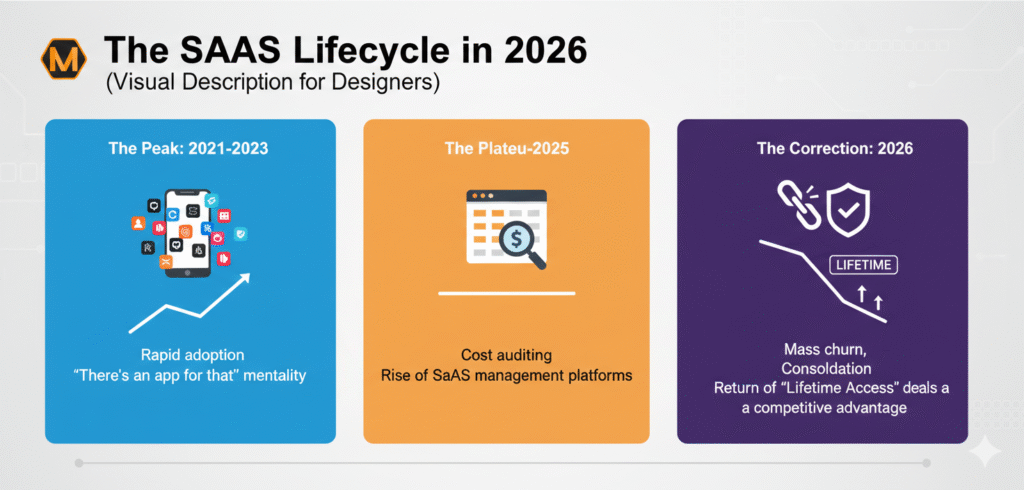
Why 2026 is the Year of the “Great Unsubscribe“
Several economic levers have pulled the trigger on the current state of subscription fatigue:
- AI Integration Surcharges: Almost every SaaS provider in 2026 has integrated generative AI, often passing the “compute cost” to the user via a $20/month premium. Users are now facing “AI Fatigue,” refusing to pay for five different LLM integrations across five different tools.
- The Death of “Freemium”: As venture capital remains disciplined, the “forever free” tiers have vanished. Barriers to entry are higher, making users more hesitant to “try” new software.
- Pricing Complexity: Tiered pricing has become so convoluted that companies are hiring “SaaS Spend Managers” just to decipher their monthly AWS or Salesforce bills.
Strategies for SaaS Survival
To survive the 2026 market, software providers are pivoting their economic models:
- Usage-Based Pricing: Moving away from flat monthly fees to “pay-per-unit” models.
- Interoperability: Tools that don’t play well with the existing ecosystem (Slack, Microsoft 365, etc.) are being cut first.
- The “Human” Value-Add: Providing expert-led support and community features that a self-service bot cannot replicate.
Key Takeaways
- Consolidation is King: 2026 is defined by users moving toward platforms that offer multi-functional utility rather than niche tools.
- Economic Rationalism: Both B2B and B2C sectors are performing rigorous “SaaS Audits,” cutting any tool with a ROI lower than its annual cost.
- The Utility Shift: Value is shifting from the software to the outcome. Users want solutions, not just licenses.
- Psychological Fatigue: Cognitive load is a real factor in churn; if your UI is complex, your renewal rate will suffer.
FAQ Section
Q1: What exactly is Subscription Fatigue?
Subscription fatigue is the exhaustion felt by consumers and businesses due to the sheer volume of recurring monthly payments and the management of multiple digital accounts.
Q2: How can businesses reduce their SaaS spend in 2026?
Audit your stack for redundant features, negotiate for usage-based pricing, and consider consolidating multiple niche tools into a single comprehensive platform.
Q3: Is the SaaS model dying?
No, but it is maturing. The “low-value, high-cost” subscriptions are being purged, while “mission-critical” software remains robust.
Q4: Will “Lifetime Deals” return?
Yes. In 2026, we are seeing a resurgence of “Pay once, own forever” models as a way for new startups to gain market share from established subscription giants.
References
- Gartner Forecasts: The Future of Public Cloud Services, 2024-2026.
- The 2026 SaaS Index: Utilization vs. Expenditure Report.
- Journal of Consumer Psychology: The Mental Overhead of Recurring Liabilities.
Author Bio:
David Miller is a Senior Research Analyst at MyAssignmentHelp. With over a decade of experience in tech economics and academic consulting, David specializes in analyzing market trends that bridge the gap between education and technology. He is a frequent contributor to tech journals, focusing on how digital transformation impacts the global economy and student accessibility.