
Introduction
Many students, players, coaches, and sports enthusiasts struggle to understand the exact layout of a kabaddi court, including its dimensions, zones, boundary lines, and playing areas. Without a clear understanding of the kabaddi court diagram, it becomes difficult to learn the rules, conduct matches, or prepare for physical education exams and competitions. Fortunately, understanding a kabaddi court is simple when you break it down into its key components, including the midline, baulk line, bonus line, lobby area, and boundaries. This comprehensive guide explains every part of the kabaddi court diagram, official measurements, court markings, and their role in the game.
What Is a Kabaddi Court Diagram?
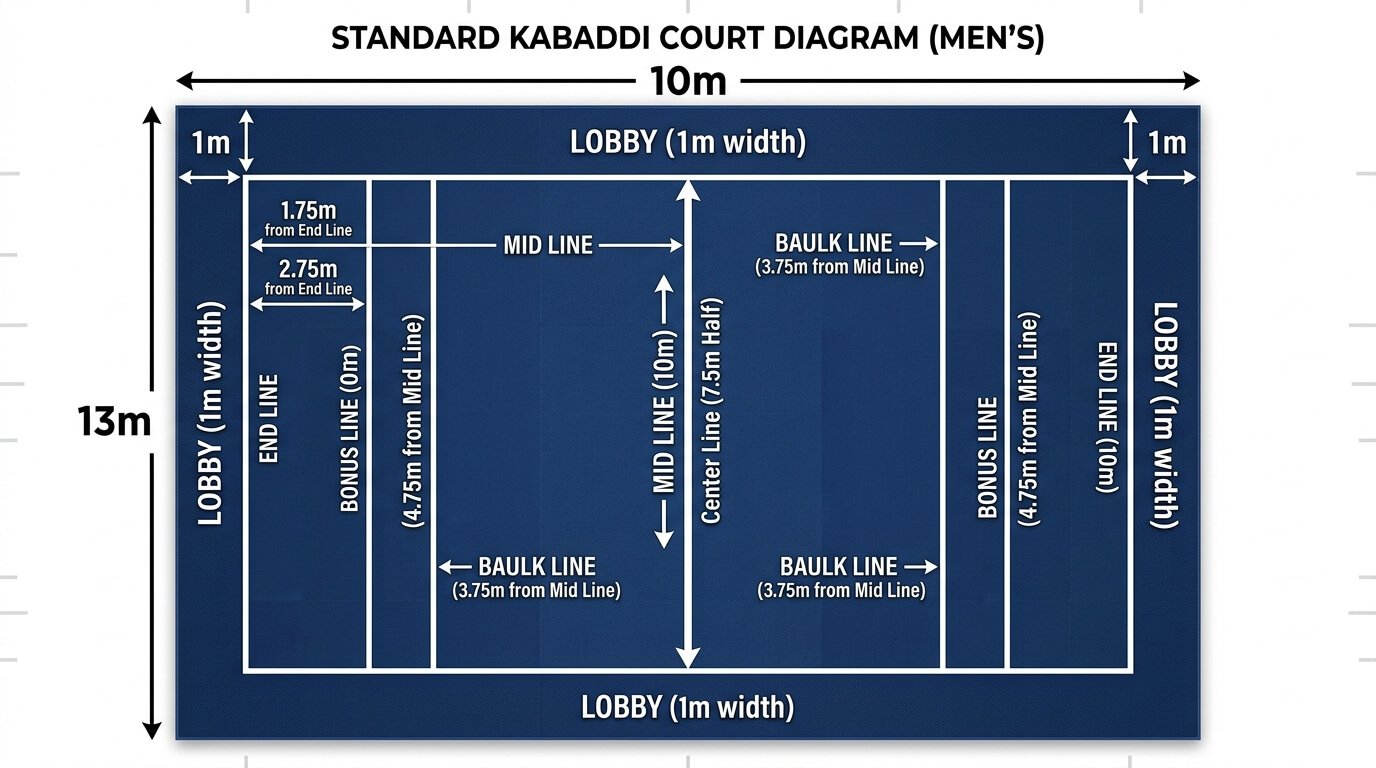
A kabaddi court diagram is a visual representation of the playing area used in kabaddi. It shows the dimensions, markings, zones, and boundaries that players must follow during a match.
The diagram serves several purposes:
- Helps players understand court positioning
- Assists referees in enforcing rules
- Supports coaches during training
- Aids students in learning the game
- Provides standard measurements for competitions
Understanding the court layout is essential for anyone involved in kabaddi.
Overview of a Standard Kabaddi Court
Kabaddi is played on a rectangular court divided into two equal halves.
Main Features of the Court
The court includes:
- Midline
- Baulk line
- Bonus line
- Lobby area
- End lines
- Side boundaries
- Sitting block
- Team area
Each section has a specific role during gameplay.
Official Kabaddi Court Dimensions
Court dimensions vary slightly depending on age group and competition category.
Men’s Court Dimensions
- Length: 13 meters
- Width: 10 meters
Women’s Court Dimensions
- Length: 12 meters
- Width: 8 meters
Junior Categories
Court sizes may be adjusted according to federation regulations.
These dimensions are commonly followed in national and international tournaments.
Understanding the Kabaddi Court Diagram
A kabaddi court is divided into two equal sections by a central line.
Court Structure
The court consists of:
- Playing area
- Lobby
- Team seating area
- Scoring zones
- Raid zones
The diagram helps players visualize movement and strategy.
Main Components of a Kabaddi Court Diagram
Midline
The midline divides the court into two equal halves.
Functions:
- Separates teams
- Starting point for raids
- Determines successful raid completion
A raider must cross the midline to enter the opponent’s half.
Baulk Line
The baulk line is one of the most important markings.
Purpose:
- Raider must cross it to make a valid raid
- Encourages active offensive play
Failure to cross the baulk line may result in an unsuccessful raid.
Bonus Line
The bonus line offers additional scoring opportunities.
Conditions:
- Bonus points are available when six or more defenders are present.
- The raider must cross the bonus line while maintaining proper body control.
End Line
The end line forms the rear boundary of the court.
Crossing it results in the player being declared out.
Side Boundary Lines
These lines define the width of the court.
Players stepping outside these boundaries are generally declared out unless specific rules apply.
Lobby Area in Kabaddi
The lobby is a special zone located along both side boundaries.
Importance of the Lobby
The lobby becomes active only when contact occurs between a raider and defender.
Functions of the Lobby
- Creates tactical movement options
- Expands playing space during contact situations
- Influences defensive formations
Understanding lobby rules is critical in professional kabaddi.
Sitting Block and Team Area
Each team has designated seating areas outside the playing court.
Purpose of Sitting Blocks
- Accommodate substitute players
- Organize team members
- Assist officials during player rotations
These areas are clearly marked in official court diagrams.
Kabaddi Court Zones Explained
Raider’s Zone
The area entered by the attacking player during a raid.
Defender’s Zone
The half occupied by the defending team.
Bonus Zone
The area beyond the bonus line where extra points may be earned.
Lobby Zone
Activated during physical contact.
Understanding these zones helps players develop better game awareness.
Importance of Boundary Lines in Kabaddi
Boundary lines maintain fairness and structure.
Why Boundaries Matter
- Define legal playing area
- Prevent unfair movement
- Assist referees in decision-making
- Maintain consistent gameplay
Players must remain within the designated boundaries during active play.
How to Draw a Kabaddi Court Diagram
Drawing a kabaddi court is often required in sports education and physical training programs.
Step 1: Draw a Rectangle
Create the outer boundary according to official measurements.
Step 2: Draw the Midline
Divide the court into two equal halves.
Step 3: Add the Baulk Lines
Draw baulk lines parallel to the midline.
Step 4: Mark Bonus Lines
Add bonus lines in each half.
Step 5: Draw the Lobby Areas
Mark the side lobby sections.
Step 6: Label All Components
Include:
- Midline
- Baulk line
- Bonus line
- Lobby
- End line
- Sitting block
A properly labeled diagram improves understanding.
Kabaddi Court Diagram for School Projects
Students frequently use kabaddi court diagrams in:
- Physical education assignments
- Sports projects
- Practical examinations
- Competitive sports studies
Tips for Better Presentation
- Use scale measurements
- Label all lines clearly
- Use rulers for accuracy
- Include dimensions
A neat diagram demonstrates knowledge of the sport.
Kabaddi Court Diagram in Professional Competitions
Professional leagues follow strict standards.
International Standards
Tournament organizers ensure:
- Accurate measurements
- Proper line markings
- Certified playing surfaces
- Adequate lighting
Standardization helps maintain fairness across competitions.
Role of Court Layout in Kabaddi Strategy
Court design directly affects gameplay.
Offensive Strategy
Raiders use:
- Bonus line opportunities
- Boundary awareness
- Midline timing
Defensive Strategy
Defenders focus on:
- Corner positioning
- Chain tackles
- Lobby control
Successful teams understand every section of the court.
Common Mistakes While Understanding Kabaddi Court Diagrams
Many beginners misunderstand key court markings.
Common Errors
- Confusing baulk and bonus lines
- Ignoring lobby activation rules
- Incorrect court measurements
- Poor diagram labeling
Learning official court standards helps avoid these mistakes.
Benefits of Understanding the Kabaddi Court Diagram
A strong understanding provides:
- Better gameplay knowledge
- Improved coaching ability
- Accurate officiating
- Enhanced tactical awareness
- Better exam preparation
Every kabaddi player should know the court layout thoroughly.
Frequently Asked Questions
What is the standard size of a kabaddi court?
The standard men’s court is generally 13 meters × 10 meters, while the women’s court is 12 meters × 8 meters.
What is the purpose of the baulk line?
The baulk line ensures the raider enters deep enough into the opponent’s territory for a valid raid.
What is the bonus line in kabaddi?
The bonus line allows a raider to earn an additional point under specific conditions.
When does the lobby become active?
The lobby becomes active when contact occurs between the raider and defenders.
Why is the kabaddi court diagram important?
It helps players, coaches, students, and officials understand the playing area and game rules.
Conclusion
The kabaddi court diagram is the foundation of understanding how kabaddi is played. Every line, zone, and boundary serves a specific purpose that influences gameplay, scoring, strategy, and officiating. From the midline and baulk line to the bonus line and lobby area, each component contributes to the structure and excitement of the sport. Whether you are a student preparing a school project, a beginner learning the game, or a coach training athletes, understanding the kabaddi court diagram is essential for mastering the fundamentals of kabaddi. By learning the official layout, dimensions, and court markings, you can gain deeper insight into one of the world’s most exciting traditional sports.